
H2BLUE launches in Brussels to build Europe’s first end-to-end green hydrogen value chain for Atlantic fisheries
European researchers and industry leaders gathered in Brussels on October 14 for the launch of H2BLUE, a three-year project set to introduce green hydrogen across Atlantic fishing, shipping, and aquaculture operations.
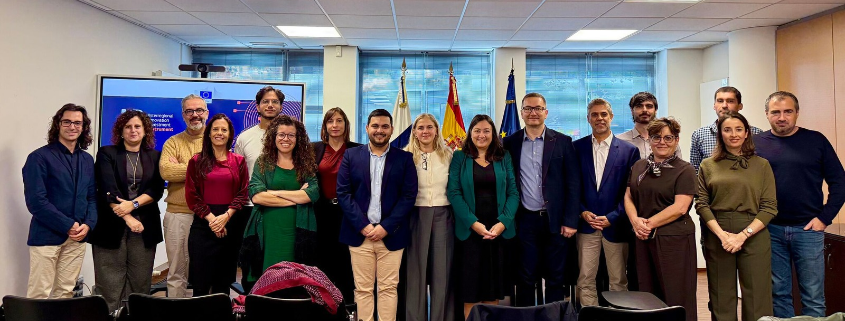
H2BLUE Project Partners – Photo Credit: Consulta Europa.
Integration of Green Hydrogen for the Decarbonization of the Aquaculture and Fisheries Value Chain (H2BLUE) is a European Project that brings together 17 partners across Spain, Portugal, and Bulgaria to deploy renewable hydrogen solutions across Atlantic Island regions. Coordinated by the Oceanic Platform of the Canary Islands (PLOCAN) and funded with €7 million through the European Commission’s Interregional Innovation Investments programme (#I3Instrument)—managed by the European Innovation Council and SMEs Executive Agency (EISMEA)—the effort aims to reduce carbon emissions by up to 80% compared with conventional marine diesel.
Rather than running isolated technology trials, H2BLUE has been designed around a complete, end-to-end value chain. Over the next 36 months, demonstration activities across the Canary Islands and the Azores will link every stage of the clean energy cycle directly to real-world maritime operations.
On the supply side, coastal sites will see the installation of pilot green hydrogen refuelling stations alongside localised production systems. Out at sea, technical teams will integrate a 20 kW fuel-cell power unit onboard an offshore aquaculture service vessel, alongside testing hydrogen-powered auxiliary systems used in feeding operations.
The initiative also builds circularity directly into the process. Oxygen produced as a natural by-product during hydrogen generation will be captured and repurposed for onshore fish farming facilities to boost operational efficiency and eliminate waste.
To ensure these technologies take root locally, H2BLUE will establish direct links with regional small and medium-sized enterprises (SMEs), offering tailored training programmes and support schemes to help local businesses adopt and replicate hydrogen solutions.
Speaking at the launch, European Commission representatives highlighted the role of Europe’s outermost islands as living laboratories capable of testing scalable clean-energy models for coastal communities across the continent.
With initial meetings concluded, technical teams are now moving forward with site feasibility and engineering studies across Gran Canaria and La Palma in Spain, and the Azores in Portugal, alongside mapping regional innovation networks to prepare for broader market adoption.
