
The H2TRUCK Project, with CNH2 Participation, Successfully Concludes and Is Recognised at the SmartCity Expo World Congress
Last updated on 02 June, 2025
The H2TRUCK project has successfully concluded, with its results showcased at the SmartCity Expo World Congress, where it received the Energy and Urban Environment Award. This event is the world’s leading gathering on cities and urban innovation, bringing together top executives from major companies and organisations, as well as government representatives.
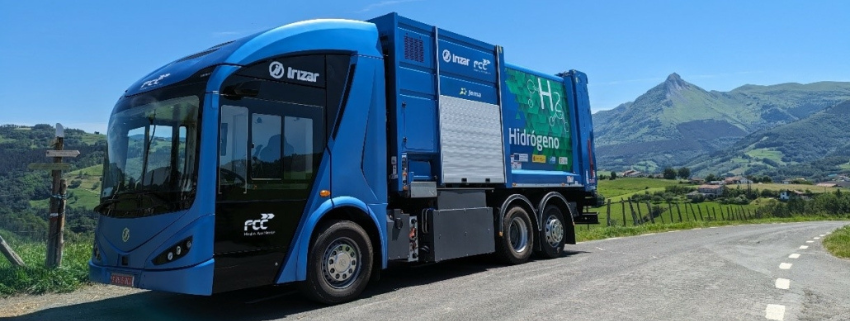
The H2TRUCK initiative has led to the development of a fully operational prototype vehicle, which has already been tested in real-life waste collection routes across several Spanish cities.
The project’s main objective was the development of a heavy-duty modular chassis-platform, powered by a hybrid system combining hydrogen fuel cells and lithium-ion batteries. This flexible design enables future adaptation to urban services such as waste collection or street cleaning, regardless of axle configuration or vehicle body type. The first application of the H2TRUCK platform was implemented on a 21 m³ side-loading compactor refuse collector.
H2TRUCK was carried out by a consortium led by FCC Medio Ambiente, and included companies such as Irizar, Jema, and Calvera, as well as public research institutions (OPIs) such as INSIA, Tecnalia, Cidetec, and the Spanish National Hydrogen Centre (CNH2).
CNH2’s role focused on conducting the testing campaign for the fuel cell system and DC/DC converter. This phase enabled the characterisation of the propulsion system’s performance, a crucial step before full system integration into the platform, and contributed to optimising energy efficiency. Thanks to CNH2’s in-depth analysis, assembly times and control system programming were significantly reduced.
The project, titled “Research and Development of a New Heavy-Duty Vehicle for Urban Service Applications Using Hydrogen-Powered Hybrid Battery–Fuel Cell Technology (H2TRUCK)”, file number PTAS-20211014, was funded by the Centre for the Development of Industrial Technology (CDTI) and supported by the Ministry of Science and Innovation under the 2021 call of the Sustainable Automotive Technology Programme, within the framework of Spain’s Recovery, Transformation and Resilience Plan, financed by the European Union.
