
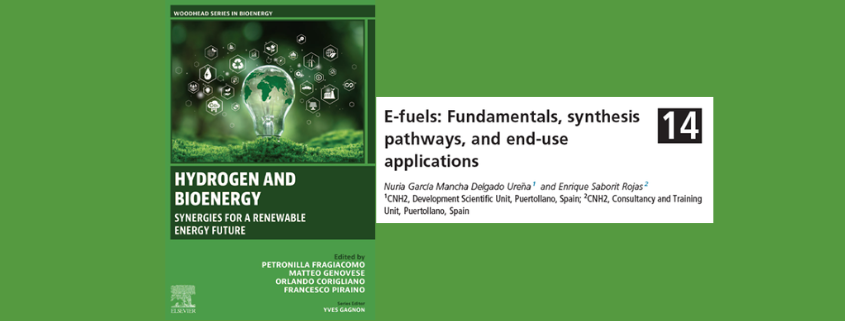
The CNH2 has contributed to the book “Hydrogen and Bioenergy” with a chapter on e-fuels and decarbonisation
Researchers from the National Hydrogen Centre (CNH2), Enrique Saborit, from the Consultancy and Training Unit, and Nuria García-Mancha, head of the Advanced Technologies for the Production of Eco-Fuels Unit (UTAPE), have contributed as authors to Chapter 14 of the book Hydrogen and Bioenergy: Synergies for a Renewable Energy Future, published by the international publisher Elsevier.
The chapter, entitled “E-fuels: Fundamentals, synthesis pathways, and end-use applications”, examines the strategic role of e-fuels as a solution for moving towards a sustainable, decarbonised energy model, particularly in sectors where direct electrification is more challenging, such as heavy transport, aviation, industry, and certain thermal applications.
The publication examines how e-fuels are establishing themselves as a low-carbon alternative to help meet the climate targets set out in the Paris Agreement. These synthetic fuels are produced using Power-to-X (PtX) technologies, which combine renewable hydrogen — obtained through electrolysis powered by renewable energy — with captured CO₂ or nitrogen from the air to generate sustainable liquid and gaseous fuels.
The fuels examined in this chapter include e-methane, e-methanol, e-diesel, e-petrol, e-aviation fuel and e-ammonia, all of which have the potential to replace conventional fossil fuels, in many cases by making use of existing infrastructure.
The research carried out by Enrique Saborit and Nuria García-Mancha also highlights the benefits of e-fuels as a means of large-scale energy storage and reducing greenhouse gas emissions, as well as the challenges associated with their production costs and the need to continue making progress in the technological and commercial development of these solutions.
The book Hydrogen and Bioenergy: Synergies for a Renewable Energy Future brings together contributions from international experts and examines the synergies between hydrogen, bioenergy and synthetic fuels as key elements in accelerating the energy transition and moving towards a climate-neutral economy.
